
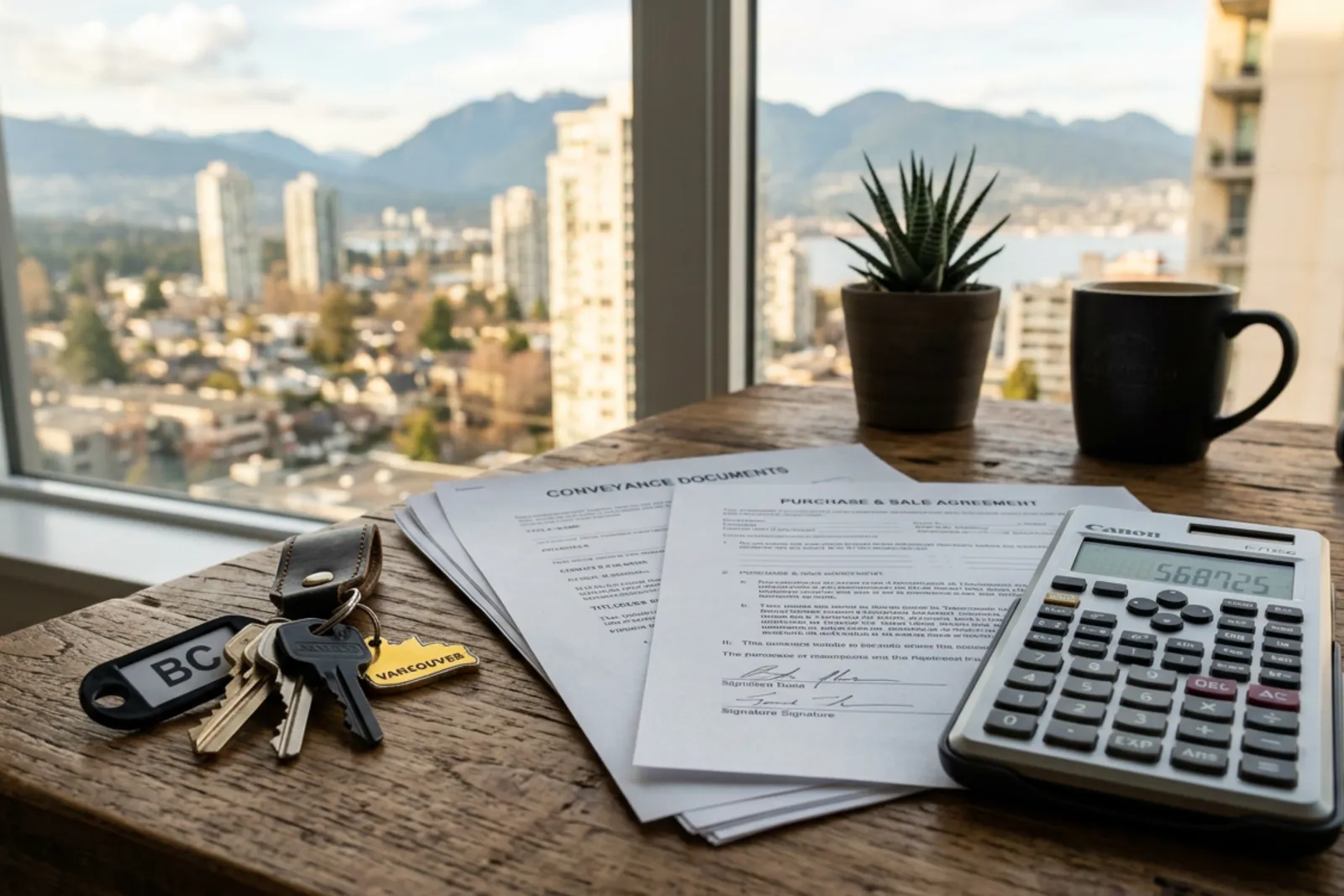
Vancouver Home-Closing Costs: A Practical Checklist for B.C. Buyers
Understand Vancouver home closing costs, from property transfer tax to legal fees and insurance. Use this practical B.C. buyer checklist today.
September 14, 2026
Buying a home in Vancouver involves more than saving a down payment and qualifying for a mortgage. Before you receive the keys, you will need cash for taxes, legal work, registration, insurance, and several smaller items that can add up quickly.
The exact amount depends on the property type, price, financing, and whether you qualify for a tax exemption. A condo purchase also brings strata documents, fees, and possible special levies into the picture. There is no universal closing-cost number that fits every buyer, but a clear checklist makes the process much less stressful.
This guide covers the major home-closing costs Vancouver buyers should factor into their financial planning before submitting an offer.
Start With Your Cash-to-Close Estimate
Your cash to close is the amount you need to provide shortly before completion. It usually includes your remaining down payment, property transfer tax where applicable, legal fees, registration fees, adjustments, and mortgage-related charges.
The deposit paid after an accepted offer is generally credited toward your down payment. It is not an extra closing cost, though it does require accessible funds early in the transaction.
A useful working formula is:
Remaining down payment + property transfer tax + legal and registration costs + title insurance + adjustments + lender or appraisal charges = estimated cash to close
This estimate will change as the closing date approaches. Your lawyer or notary prepares a statement of adjustments that sets out the final figure, usually shortly before completion.
For buyers stretching to make a competitive offer, this distinction matters. A down payment is only part of the money needed. Assuming every available dollar can go toward the purchase price can leave an unpleasant gap at closing.
Property Transfer Tax Is Usually the Largest Closing Cost
Property Transfer Tax, usually called PTT, is one of the biggest costs for B.C. home buyers. It is charged when the title is registered at the Land Title Office. The purchaser is responsible for paying it unless an exemption applies.
PTT is based on the property’s fair market value at the registration date. It is separate from annual property taxes. Annual municipal taxes fund local services, while PTT is a provincial tax triggered by the purchase and registration of real estate.
For many residential purchases, the standard PTT calculation is:
1% on the first $200,000 of the property value
2% on the portion between $200,000 and $2 million
3% on the portion between $2 million and $3 million
5% on the portion above $3 million
A home purchased for $1 million, for example, would generally have PTT of $18,000:
1% of the first $200,000 = $2,000
2% of the next $800,000 = $16,000
That is a significant amount of cash, especially in Vancouver, where property values often put buyers well above the lowest tax bracket.
Certain residential properties may also be affected by the additional property transfer tax for foreign entities and taxable trustees. Rules in this area are detailed and fact-specific, so buyers with citizenship, residency, corporate ownership, trust ownership, or partnership arrangements should obtain legal advice before removing conditions.
Check First-Time and New Home Buyer Exemptions Early
B.C. has exemptions that may reduce or eliminate PTT for qualifying buyers. The First Time Home Buyers’ Program is the one most people know, but eligibility has several conditions. A buyer generally needs to meet requirements related to Canadian citizenship or permanent residency, B.C. residency, prior home ownership, property value, and use of the home as a principal residence.
The program may provide a full or partial exemption depending on the purchase price and other criteria. Buyers should not assume they qualify simply because this is their first purchase. A person who has owned an interest in a home before, including outside Canada, may not meet the program’s definition of a first-time buyer.
There are also PTT exemptions and relief measures for some newly built homes. These programs have their own price thresholds and requirements, which can change. If an exemption is central to making your budget work, confirm it before you make an offer, not during the final week before closing.
Your lawyer or notary can usually apply the exemption during the registration process if you qualify. You will need to provide accurate supporting information and sign the relevant declarations.
Legal Fees, Notary Fees, and Disbursements
In B.C., a lawyer or notary typically handles the legal side of a residential real estate closing. Their work is not a formality. They review title, prepare and explain documents, calculate adjustments, register the transfer and mortgage, receive mortgage funds, and distribute money to the appropriate parties.
Costs vary with the file’s complexity. A straightforward purchase with one mortgage is usually less expensive than a transaction involving a private lender, multiple buyers, a trust, a separation, a corporation, a presale assignment, or title complications.
Ask for a written estimate that separates professional fees from disbursements. Disbursements are third-party costs paid while completing the transaction. They may include title searches, tax certificates, courier charges, electronic filing fees, registration fees, and identity verification.
Comparing quotes is sensible, but the cheapest option is not automatically the best choice. A real estate closing has deadlines, large fund transfers, and legal consequences. Clear communication and careful work are worth something.
Land Title Office Registration Fees
When you buy a home, the transfer of title must be registered with the B.C. Land Title and Survey Authority. If you have a mortgage, your lender’s charge must usually be registered as well.
These fees are standardized and depend on the number and type of documents filed. They are usually included on your legal statement as a disbursement rather than billed separately by the registry.
The amounts may look modest beside PTT, but they are still part of the final cost. Buyers should also remember that a purchase can require more than one filing. A title transfer, mortgage registration, and other documents may each have associated charges.
Title Insurance: A One-Time Layer of Protection
Title insurance is commonly purchased during a B.C. real estate transaction. It is generally a one-time premium rather than a monthly insurance payment.
A title insurance policy can protect a buyer and lender against certain title-related risks. Depending on the policy, these risks may include title fraud, undisclosed liens, survey issues, certain zoning problems, unregistered easements, and errors in public records.
It does not replace home insurance. Home insurance covers risks such as fire, water damage, theft, and liability. Title insurance relates to ownership rights and title defects.
Your legal representative can explain the available coverage and whether it is required by your lender. Read the policy terms rather than relying on the label alone. Coverage varies, exclusions exist, and title insurance is one piece of a broader risk-management plan.
Mortgage and Financing Costs
A mortgage can bring several costs beyond the interest rate. Some are paid before closing, some are paid at closing, and some may be added to the mortgage balance.
Potential charges include:
Appraisal fees, if your lender requires an independent valuation
Lender administration or commitment fees
Mortgage default insurance, where the down payment is below 20%
Legal costs for the lender, in some financing arrangements
Interest adjustments, depending on the funding date and payment schedule
For buyers making a down payment of less than 20%, mortgage loan insurance is commonly required. In many cases, the insurance premium is added to the mortgage rather than paid as a lump sum at closing. Provincial sales tax on the insurance premium may still need to be paid in cash on closing, depending on the financing structure.
Mortgage default insurance is easy to misunderstand. It protects the lender if the borrower defaults. It may help a buyer access financing with a smaller down payment, but it is not personal mortgage insurance that protects the homeowner’s income or family.
Review your mortgage commitment carefully. The interest rate gets most of the attention, understandably, but the terms matter too. Prepayment rules, portability, penalties, renewal options, and conditions for funding can affect the long-term cost of the home.
The Statement of Adjustments Can Change Your Final Number
The statement of adjustments divides property-related costs between the buyer and seller based on the completion date. It is one of the most important documents in the closing process because it converts estimates into the amount you actually need to provide.
Common adjustments include property taxes, utility charges, strata fees, and prepaid services. If the seller has paid an annual bill that covers time after the buyer takes possession, the buyer may reimburse the seller for that period. If an amount is unpaid and relates to the seller’s ownership period, the seller may receive a credit.
Here is a simple example. Suppose annual property taxes are $6,000 and the seller has already paid them in full. If you take ownership halfway through the year, you may reimburse the seller for roughly half the taxes through the adjustment statement.
The reverse can also happen. If taxes have not been paid, the seller may be charged for the portion that relates to their ownership period.
Buyers sometimes see adjustments as surprise costs. They are usually not new fees. They are a fair allocation of bills attached to the property. Still, they can be substantial, particularly if the seller prepaid taxes, strata fees, or a major utility charge.
Extra Due Diligence for Condos and Strata Homes
A strata property has a different set of financial questions than a detached house. The monthly strata fee is the obvious one, but it is only the starting point.
Before closing, review the strata corporation’s documents carefully. These often include bylaws, recent meeting minutes, financial statements, the depreciation report if available, insurance information, the current budget, and details of the contingency reserve fund.
Pay particular attention to special levies. A special levy is an amount owners must pay for a major expense that cannot be covered through the regular operating budget or reserve fund. Building envelope repairs, elevator replacements, plumbing work, and insurance shortfalls can lead to levies that are far larger than a typical monthly strata fee.
Ask whether a special levy has been approved, proposed, or discussed in recent meeting minutes. Also confirm who is responsible for any levy due after completion. The purchase contract may address this, but the wording matters.
There can also be administrative fees for strata documents and move-in arrangements. These charges are usually smaller than a special levy, but they should still be part of the moving budget.
Home Inspections and New-Home Warranty Considerations
A pre-purchase home inspection is not mandatory, but it is often money well spent. The cost depends on the property size, age, location, and inspection scope. Older detached homes may need more specialized review, such as sewer scopes, electrical inspections, asbestos testing, or assessments of oil tanks.
In B.C., home inspectors must be licensed by Consumer Protection BC. A licensed inspector follows statutory requirements, but an inspection still has limits. It is a visual assessment, not a guarantee that every issue will be found. Read the report closely and ask direct questions about urgent repairs, safety issues, moisture, roof condition, heating systems, and likely maintenance costs.
For recently built homes, ask about the 2-5-10 new home warranty. This coverage is administered through B.C. Housing Licensing & Consumer Services for registered new homes still under warranty. Confirm whether the warranty remains in place, what coverage periods apply, and whether any transfer or administrative steps are required.
A new home may need fewer immediate repairs, but it is not automatically risk-free. Presale purchases, occupancy dates, GST issues, developer disclosures, and warranty documentation can all require close attention.
Annual Vacancy and Speculation Taxes Are Separate Matters
Some property-related taxes are not paid at closing, but buyers should understand them before they purchase.
B.C.’s Speculation and Vacancy Tax applies annually in designated taxable areas and is based on how residential property is used. Owners in those areas generally need to file a yearly declaration. The tax is aimed at residential properties left vacant or not used in a way that meets the exemption rules.
Vancouver buyers should also know that the provincial tax is separate from the City of Vancouver Empty Homes Tax and the federal Underused Housing Tax. These taxes have different rules, filing requirements, exemptions, deadlines, and enforcement processes.
Do not assume a property is exempt because it is a principal residence, a rental property, or newly purchased. Those facts may matter, but each tax has specific definitions. Use the provincial speculation and vacancy tax map to check whether the property is in a taxable area, then review the applicable municipal and federal obligations.
Missing a declaration can create problems even where no tax is ultimately owed.
The B.C. Home Flipping Tax Matters When Planning a Resale
The B.C. home flipping tax applies to income from the sale of residential property sold on or after January 1, 2025, where the property was owned for less than 730 days, unless an exemption applies.
This is mainly a seller-side consideration, but buyers should understand it when planning a purchase. Life can change quickly. A job relocation, divorce, disability, death, safety issue, or other major event may affect whether an exemption is available. The rules are not designed to treat every short-term sale the same way, but buyers should not assume a quick resale will be tax-free.
The tax may also affect presale contract assignments and recently acquired homes. If you are purchasing a property that has changed hands quickly, ask questions about the seller’s circumstances and ensure the transaction documents are handled properly.
Capital gains tax is another separate issue. A principal residence exemption often applies when a homeowner sells their primary home, but it does not apply automatically in every situation. Real estate used as an investment, a rental, or part of a short-term resale strategy may have different tax treatment.
A Closing Checklist for Vancouver Buyers
Before subjects are removed and before funds are due, work through the practical details:
Confirm the down payment, deposit credit, and estimated cash-to-close amount.
Check your eligibility for Property Transfer Tax exemptions.
Obtain a clear quote from your lawyer or notary, including disbursements.
Review mortgage conditions, appraisal requirements, and any default insurance charges.
Arrange home insurance effective on the completion date if required by your lender.
Review the statement of adjustments before sending closing funds.
For strata properties, read the documents and investigate special levies, insurance deductibles, and reserve funding.
Check annual declaration obligations for vacancy-related taxes.
Keep a separate moving and repair reserve if your budget allows.
Closing With Fewer Surprises
A well-planned purchase is less about predicting every dollar perfectly and more about knowing what questions to ask. Property Transfer Tax, legal fees, title insurance, registration costs, and adjustments should all be part of the conversation before you commit to a property.
For many buyers, the most useful step is to get early estimates rather than waiting for the final week. Speak with your mortgage provider, lawyer or notary, insurer, and qualified tax or financial planning professional. They can help you understand the costs connected to your circumstances, financing, and intended use of the home.
Buying real estate in Vancouver is a major financial decision. A realistic closing budget gives you room to focus on the home itself, rather than scrambling to cover costs when completion day arrives.
Planning your next financial move?
Insurance, investment, mortgage and real estate guidance under one roof.
Get Great Advice